

The metaverse has been a big topic in conversations I’ve had recently. They’ve spanned from trying to explain what it is, why Facebook shouldn’t have any part in owning it, my opinion on the development of this concept and whether it’s something we are already living in.
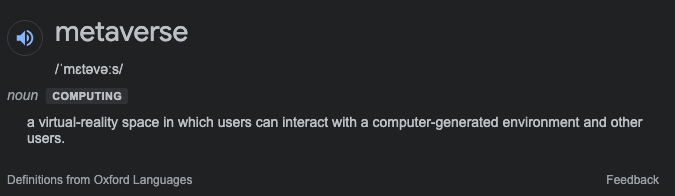
To me, the definition makes me feel as if we’ve had the metaverse integrated into our lives since the birth of online gaming – even something as simple as Club Penguin loosely fits this definition, while Minecraft, Call of Duty and other games with 3D rendered worlds are much stronger examples with a complete contrast in graphics.
I think the keyword to focus on here is ‘virtual-reality’ (VR), a space which can currently only be explored via headset. Looking at the current market for these products, there’s a pretty large issue surrounding this.
With more people opening up to a decentralised network in a push towards Web3.0, having to use particular equipment to access the elements of this new digital reality is completely backwards. Looking further into it, Oculus is the market leader in VR. Meta (previously Facebook) own Oculus. Mark Zuckerberg made the announcement that kickstarted the metaverse narrative, seeing tokens like $SAND and $MANA explode in the weeks following the rebrand. Add all of this to Facebook’s reputation for handling data, and this concept appears to get worse the further you research down this route.
Niantic – Augmented vs Virtual Reality
Moving away from the virtual reality perspective, there’s the possibility to integrate the metaverse into real life in a more convenient way by using augmented reality (AR). I believe this should be the way forwards as it keeps aspects of real-life and a digital reality separate while still being extremely accessible.
Take Pokemon Go as an example. You walk around the real world waiting for Pokemon to pop up in front of you on the map, and using AR you can see the Pokemon as if it’s directly in front of you. A technology that became popular with the game release, and still has between 6 and 7 million daily players.

Looking further than gaming, augmented reality is already used in a lot of real-life scenarios. Matterport exists to build 3D models of buildings so that they can be toured virtually; IKEA has an AR app that allows the user to see how furniture would fit into a room before committing to a purchase, and I’m sure we’ve all seen a menu/poster that you can scan to bring to life in some way or another. More recently, fashion has fallen into AR, with companies such as RTFKT (recently acquired by Nike), and digital fast-fashion companies like ZERO10 and Republiqe.
Niantic (the company behind Pokemon Go) has the ability to map the world from eye level purely by collecting data from Pokemon Go players, and potentially use AI to differentiate between materials, weather and landscapes, which could open augmented reality to a new wave of possibilities.
Why are there so many choices?
Regardless of whether this concept goes down the route of virtual reality, augmented reality or simply just looking at a screen, there is still one issue that leaves a cloud over the entire ‘decentralisation’ narrative.
To reach the desired outcome of being a decentralised space, interoperability needs to be a key aspect.
If different networks can’t work with each other, it creates giants in a similar way to how Amazon, Facebook, Google and TikTok currently hold a lot of power over what we call Web2.0. We’re able to bridge assets between networks but this can sometimes be complicated, and requires a simple solution so that all users can feel comfortable using their assets cross-chain. I believe tokens like $ATOM and $QNT provide this solution, while something like $LUNA is true decentralised money with an exponentially growing ecosystem at the moment.
If the metaverse does become the safe haven that some people are calling for, there’s a lot of things that need to be considered.
- First of all, interoperability is as necessary here as in the crypto space.
There needs to be a way for Decentraland users to enter The Sandbox metaverse and vice versa, as an example.
- A universal time zone would be required for all users to have the same experience at the same time, regardless of their local time.
- The storage and hosting of metaverse platforms needs to be decentralised.
Data should be removed from any Web2.0 solutions like Amazon Web Services, with a Web3.0 solution like Arweave ($AR) being a key component in every project. Similarly, the processing power should be from multiple sources and not just one, potentially by employing a service like Render ($RNDR).


 Zak Michaelwaite
Leave a comment